

By Yiddy Lemmer, CEO – CompuConnect, Inc.
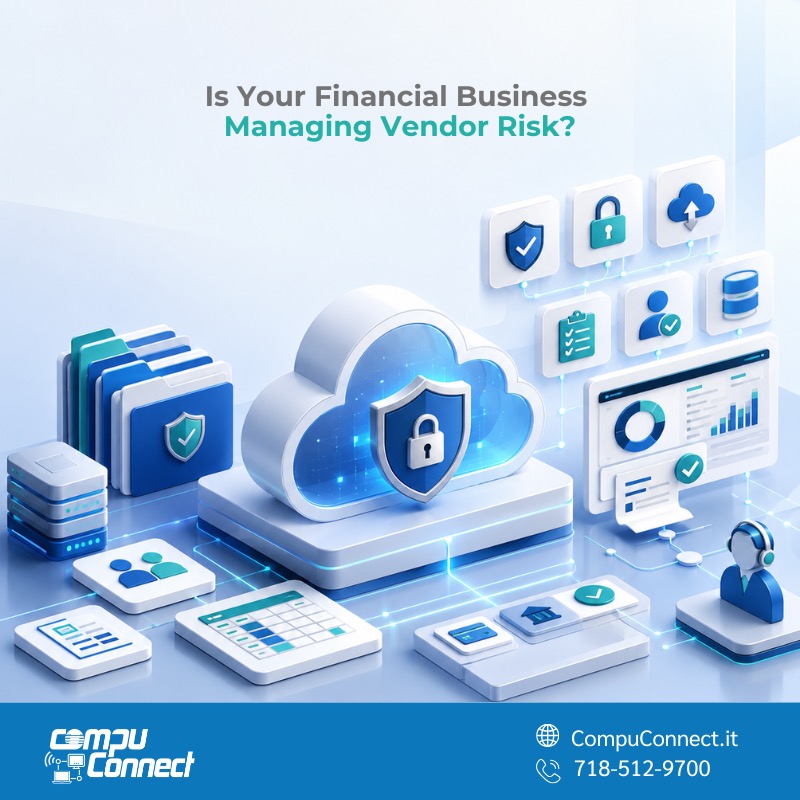
Small financial businesses rely on cloud software for daily operations, client service, document storage, communication, billing, reporting, compliance workflows, and productivity. But every vendor that touches client information, business systems, or critical workflows also creates risk.
The issue is not whether cloud software is good or bad. In many cases, the cloud gives small financial businesses better flexibility, scalability, and efficiency. The real question is whether each vendor is being reviewed, secured, monitored, and supported properly.
For financial businesses, vendor risk is business risk. A weak vendor, poor configuration, unclear contract, or unsupported cloud platform can affect client confidentiality, compliance readiness, productivity, and business continuity.
That is why cloud software decisions should not be treated as simple subscription purchases. They should be part of a larger IT and cybersecurity strategy.
Why Vendor Risk Matters for Small Financial Businesses
Small financial businesses often depend on outside platforms for essential functions. These may include:
- Client portals
- Document management systems
- Accounting or financial planning software
- CRM platforms
- Email and collaboration tools
- E-signature platforms
- Cloud storage
- Payment systems
- Reporting and workflow tools
Each tool may be useful, but each one also introduces questions:
- What data does the vendor access?
- Where is client information stored?
- Who can log in?
- Is multi-factor authentication available and enforced?
- Does the vendor encrypt data?
- What happens if the vendor has an outage?
- What happens if the vendor is breached?
- Who supports the platform when something goes wrong?
- Can the business recover data if access is lost?
Financial businesses are expected to protect customer information and maintain appropriate safeguards. The FTC Safeguards Rule requires covered financial institutions to keep customer information secure and take steps to ensure service providers also safeguard information in their care.
Cloud Software Is Not “Set It and Forget It”
Many small financial businesses adopt cloud software because it feels easier than managing on-premise systems. That can be true, but cloud platforms still need oversight.
Cloud vendors usually manage part of the environment, but your business remains responsible for how the software is selected, configured, accessed, and used.
That means financial businesses still need to manage:
- User access
- Password and MFA policies
- Device security
- Permissions
- Data sharing settings
- Backup and retention requirements
- Vendor contracts
- Employee training
- Incident response planning
- Offboarding when employees leave
A cloud tool can be secure in theory and still create risk if it is poorly configured or loosely managed.
Common Vendor Risk Problems Small Financial Businesses Overlook
Vendor risk often builds quietly. A business may add one tool, then another, then another. Over time, no one has a full picture of what systems are being used, who has access, or where client data lives.
Common problems include:
- Former employees still having access to cloud systems
- Staff using unapproved apps to store or send client files
- Vendors without clear security documentation
- Weak or optional multi-factor authentication
- Too many users with administrative permissions
- No written process for approving new tools
- No backup plan if a vendor becomes unavailable
- Unclear ownership of vendor management
- Contracts that do not clearly address data protection or breach response
- Lack of review before connecting one platform to another
These issues are not always dramatic, but they can create real operational and compliance concerns.
What Financial Businesses Should Review Before Choosing a Cloud Vendor
Before adopting a new cloud platform, small financial businesses should pause and review the vendor through a business, cybersecurity, and support lens.
Important questions include:
What Data Will the Vendor Access?
Not every vendor needs access to sensitive client information. Businesses should understand whether the platform will store or process:
- Client names and contact details
- Account information
- Tax or financial documents
- Identification records
- Payment information
- Internal communications
- Compliance-related records
The more sensitive the data, the more careful the review should be.
How Is Access Controlled?
A strong vendor should support practical access controls, including:
- Multi-factor authentication
- Role-based permissions
- Administrative controls
- User activity visibility
- Secure employee offboarding
- Strong password policies
If a platform cannot support basic access controls, it may not be appropriate for sensitive financial work.
What Happens During an Outage or Incident?
Vendor availability matters. If a key platform goes down during an important deadline, your business needs to know the impact.
Ask:
- Does the vendor publish uptime expectations?
- How does the vendor communicate outages?
- What support is available?
- What is the incident response process?
- How quickly can the business regain access?
- Is there a backup workflow?
For financial businesses, downtime can affect client confidence and staff productivity.
How Does the Vendor Protect Data?
Businesses should request or review available security documentation, including:
- Encryption practices
- Data retention policies
- Breach notification terms
- Security certifications or audit reports
- Backup and recovery practices
- Privacy policies
- Subprocessor or third-party access information
The goal is not to turn business leaders into security engineers. The goal is to make informed decisions before client information is placed into a system.
Vendor Risk Is Also a People and Process Issue
Technology controls matter, but people and processes matter just as much.
Even a secure cloud platform can create risk if employees do not know how to use it properly. For example, staff may share links too broadly, store documents in the wrong location, use personal devices, skip access reviews, or work around approved systems when they feel slowed down.
Small financial businesses should have clear internal rules for:
- Approved software
- Client file sharing
- Password and MFA use
- Remote access
- Data storage
- Employee onboarding and offboarding
- Vendor approval
- Incident reporting
- Use of personal devices
- Review of connected apps and integrations
Good policy does not need to be overwhelming. It should be practical, understandable, and easy for employees to follow.
How CompuConnect Helps Small Financial Businesses Manage Vendor and Cloud Risk
CompuConnect helps small financial businesses use cloud software with more confidence, structure, and security.
Our role is not just to respond when something breaks. We act as a proactive managed IT and cybersecurity partner, helping businesses make better technology decisions before risk turns into disruption.
We help with:
- Cloud software review and planning
- Vendor risk evaluation
- Cybersecurity assessments
- Identity and access management
- Multi-factor authentication rollout
- Email and endpoint security
- Secure file sharing practices
- Backup and recovery planning
- Employee onboarding and offboarding processes
- Technology roadmapping
- Ongoing managed IT support
Most importantly, CompuConnect provides 100% live human support. Your team reaches real people who understand your business, respond with care, and help keep your systems stable, secure, and productive.
For small financial businesses, that matters. Technology issues are rarely just technical. They affect client service, deadlines, trust, compliance readiness, and business continuity.
Schedule a Discovery Call With CompuConnect
Vendor risk and cloud software decisions should not be handled casually, especially when client information and business-critical workflows are involved.
CompuConnect can help your business review your current cloud environment, identify vendor-related risk, strengthen access controls, and create a practical technology roadmap that supports security, stability, productivity, and long-term growth.
Schedule a discovery call with CompuConnect to discuss your vendor risk, cloud software environment, and cybersecurity strategy.
Bottom Line
Cloud software can help small financial businesses work more efficiently, serve clients more effectively, and scale with greater flexibility. But every vendor relationship should be reviewed with care.
Before adding another platform, your business should know:
- What data the vendor can access
- How the software is secured
- Who manages permissions
- What happens during an outage
- How the vendor supports incident response
- Whether the tool fits your broader IT strategy
The right cloud software should strengthen your business, not create hidden risk. With the right managed IT and cybersecurity partner, small financial businesses can make smarter vendor decisions and build a more stable foundation for growth.
About the Author
 Yiddy Lemmer is the Founder and CEO of CompuConnect IT, a leading IT support and cybersecurity firm serving small and midsize businesses across New York and New Jersey. With over 18 years of hands-on experience, multiple Microsoft and CompTIA certifications, and deep roots in Brooklyn, Yiddy leads with a passion for technology, service excellence, and helping businesses thrive through secure and efficient IT systems.