


By Yiddy Lemmer, CEO – CompuConnect, Inc.
Cheap IT support can look like a smart way to save money.
Until it starts costing you more.
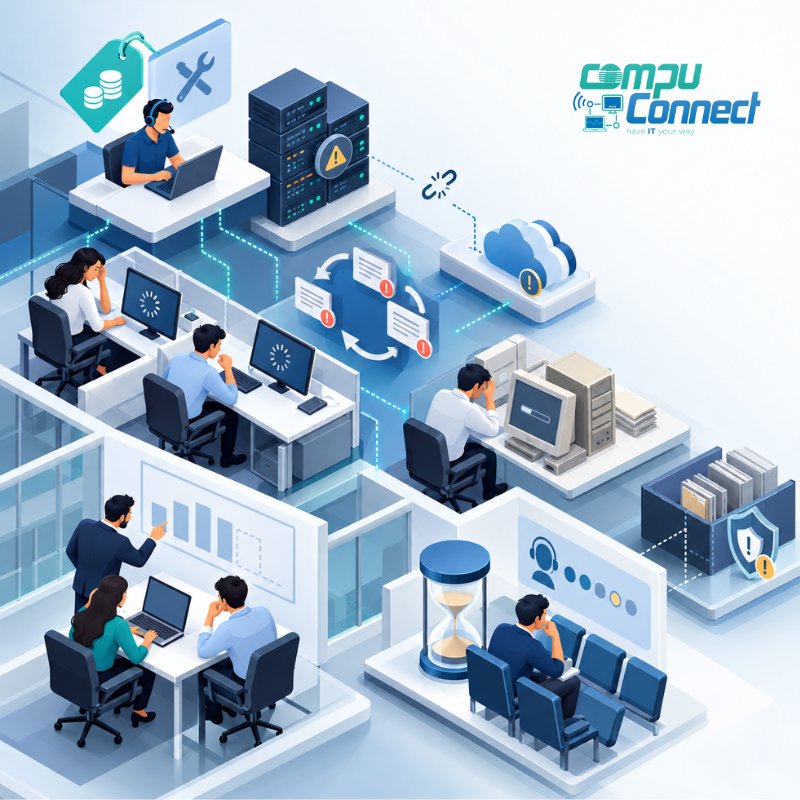
For a growing business, the real cost of IT is not just the monthly invoice. It is also the downtime, slow response, repeated problems, lost productivity, weak planning, security gaps, and time your team spends chasing answers.
That is why the lowest-cost IT option is not always the least expensive.
As your business grows, technology becomes more connected to everything you do. Employees depend on it. Clients feel the impact when it fails. Leadership depends on it to keep operations moving.
At that point, IT support needs to do more than fix things when they break.
It needs to help the business stay stable, secure, productive, and prepared.
Cheap IT Usually Looks Fine Until Something Goes Wrong
A low-cost IT arrangement may work when the environment is simple.
A few computers. A small team. Limited systems. Not much complexity.
But growth changes that.
You add employees.
You add software.
You add locations.
You rely more heavily on Microsoft 365, cloud platforms, remote access, shared files, cybersecurity tools, and business applications.
Suddenly, the questions become bigger than:
“Can someone fix this laptop?”
Now you need to know:
- Are backups working?
- Are employees getting support quickly?
- Are old systems creating risk?
- Is cybersecurity keeping up with growth?
- Are new employees being onboarded properly?
- Are former employees losing access quickly?
- Is technology being planned or just patched?
That is where cheap support can start getting expensive.
1. Slow Response Costs More Than You Think
An employee who cannot work is costing the business money.
Maybe the issue is email.
Maybe it is a login problem.
Maybe they cannot access a shared folder or critical application.
If that employee waits two hours for support, the cost is not just the IT ticket.
It is two hours of lost productivity.
Now multiply that across several employees, several issues, and several months.
The monthly IT bill may look inexpensive.
The hidden cost is not.
Good support should be measured by how quickly people get productive again, not just how cheaply the provider answers the phone.
2. Repeated Problems Are Expensive Problems
Cheap IT support often focuses on the immediate issue.
Restart the computer.
Reset the password.
Reconnect the printer.
Clear the error.
Close the ticket.
That may solve the problem today.
But if the same issue keeps coming back, your business keeps paying for it in lost time.
A strong IT partner should look for patterns.
Why does this computer keep freezing?
Why do employees keep losing access?
Why does the Wi-Fi drop every week?
Why are backups failing?
Why does the same application keep causing trouble?
The goal should not be to become very efficient at fixing the same problem over and over.
The goal should be to stop the problem from coming back.
3. Cheap IT Often Means Reactive IT
Reactive support waits for something to fail.
Then someone calls.
That model can feel inexpensive because you are only paying attention when something breaks.
The problem is that growing businesses need more planning.
Computers age.
Licenses renew.
Security requirements change.
Storage fills up.
Software reaches end of life.
New employees need access.
Old employees need access removed.
Growth creates technology decisions whether you plan for them or not.
Without proactive planning, those decisions tend to arrive as emergencies.
And emergency technology decisions are rarely the cheapest ones.
4. Downtime Gets More Expensive as You Grow
A technology problem affecting three employees is frustrating.
A technology problem affecting thirty employees is something else entirely.
The larger your business becomes, the more expensive downtime gets.
Think about what happens when:
- The internet goes down
- A server fails
- Microsoft 365 access is interrupted
- A critical application becomes unavailable
- A shared drive stops working
- A cybersecurity incident locks users out
The cost is not just technical.
It can affect payroll, scheduling, billing, customer service, sales, internal communication, and deadlines.
Growth increases the importance of stability.
Cheap IT can become very expensive when the business has no realistic recovery plan.
5. Weak Cybersecurity Can Create Bigger Costs Later
Cybersecurity is another area where businesses sometimes try to save money.
Maybe basic antivirus feels good enough.
Maybe multi-factor authentication is inconvenient.
Maybe backups are running, so nobody checks them.
Maybe employees have more access than they really need.
These shortcuts may not cause an immediate problem.
That is what makes them easy to ignore.
But when something does go wrong, the cost can be much larger than the money saved.
Strong cybersecurity should be part of normal business operations.
It should include practical controls, employee awareness, secure access, monitored backups, identity protection, and a plan for what happens if there is an incident.
Security should not be built around fear.
It should be built around keeping the business operating.
6. Your Team Should Not Become the IT Coordinator
There is another hidden cost that gets overlooked.
Your employees' time.
When IT support is weak, someone internally usually fills the gap.
An office manager calls the software vendor.
A controller follows up with the internet provider.
An operations person tries to troubleshoot a Microsoft 365 issue.
A business owner spends an hour chasing the IT company.
These are expensive people doing work they were not hired to do.
A good IT partner should take ownership.
That includes helping coordinate with software vendors, internet providers, cloud platforms, and other technology companies when needed.
Your team should not have to figure out whose problem it is.
They should have someone helping move the issue toward resolution.
7. Cheap Support Can Make Growth Harder
Growing businesses need technology to scale with them.
That means thinking ahead.
Can your systems support more employees?
Is your network ready for another office?
Are your cybersecurity controls keeping pace?
Are onboarding and offboarding consistent?
Are you buying technology strategically or one emergency at a time?
A provider focused only on keeping the monthly price low may not be having those conversations.
But avoiding them does not make the decisions disappear.
It just delays them.
And delayed technology decisions often become urgent technology expenses.
The Better Question Is Not “How Much Does IT Cost?”
A better question is:
“What is our IT helping the business avoid, improve, and prepare for?”
The right IT relationship should help reduce downtime, improve employee productivity, strengthen cybersecurity, create more predictable technology spending, and give leadership a clearer plan.
That is different from simply having someone available when a computer breaks.
For a growing business, IT should become more valuable as the company becomes more complex.
Not more frustrating.
Cheap IT Is Only Cheap If Nothing Goes Wrong
The problem with cheap IT support is not the price.
The problem is what may be missing from the price.
Planning.
Accountability.
Fast support.
Cybersecurity.
Backup monitoring.
Business continuity.
Vendor coordination.
Strategic guidance.
Those things can seem unnecessary when everything is working.
They become very important when it is not.
At CompuConnect, we help businesses take a proactive approach to managed IT, cybersecurity, planning, and business continuity, backed by 100% live human support when employees need help.
The goal is not to sell businesses more technology.
It is to help them build a more stable, secure, and predictable technology environment as they grow.
If your current IT support feels inexpensive but keeps costing your team time, productivity, and frustration, it may be worth looking at the bigger picture.
Schedule a Discovery Call with CompuConnect to talk through what is working, what is not, and whether your current IT approach is keeping up with your business.
About the Author
 Yiddy Lemmer is the Founder and CEO of CompuConnect IT, a leading IT support and cybersecurity firm serving small and midsize businesses across New York and New Jersey. With over 18 years of hands-on experience, multiple Microsoft and CompTIA certifications, and deep roots in Brooklyn, Yiddy leads with a passion for technology, service excellence, and helping businesses thrive through secure and efficient IT systems.